Supplement to the 1971 History Overview
With regard to the Distinctive Designation of
the 220th Aviation Company as "THE CATKILLERS".
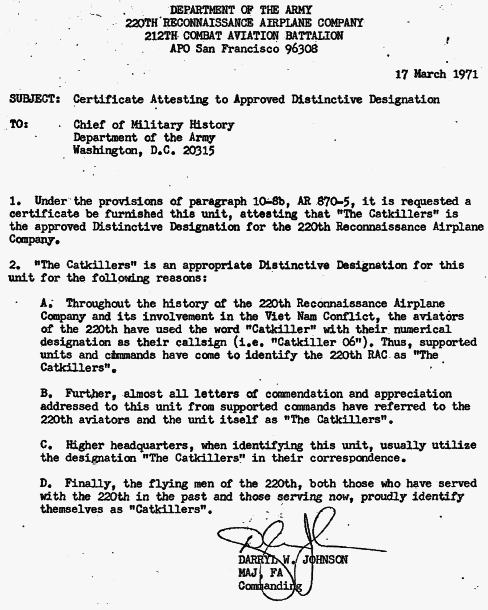
Without going into great detail, the following information is the best available in regard to the letter sent directly from the 220th to the Chief of Military History requesting a Distinctive Designation. This not an opinion, just the facts:
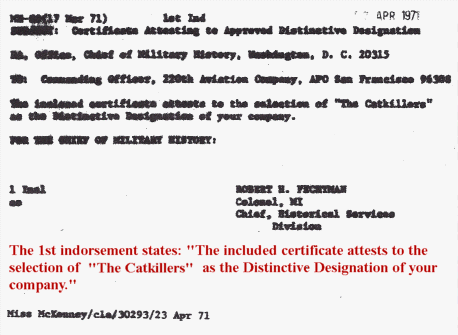
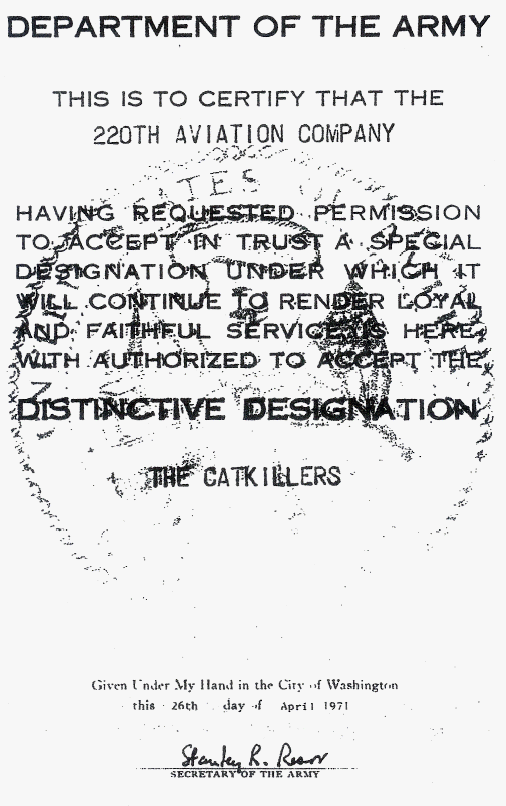
Historically speaking, and from all official records that have been located and available for the 220th Aviation Company (Surveillance Airplane, Light), as of 12 May 1969, this unit was redesignated as the 220th Aviation Company (Utility Airplane) by Department of the Army. However, it was also recognized that most of the Army O–1 companies in Vietnam at that time were known as Reconnaissance Airplane Companies or RACs (which appears to have been a ‘in–country’ designation by the 1st Aviation Brigade—to avoid any confusion with their designation of the OV–1 “Mohawk” units as Surveillance Airplane Companies or SACs.) During the research phase for the Overview of the 1971 Unit History, there was little information regarding the decision by the 13th successive unit commander to request the Distinctive Designation for the 220th Reconnaissance Airplane Company as “THE CATKILLERS.” In speaking with several officers who were in the 220th during January through May 1971, none were aware of the commander’s apparent unilateral preparation and sending of the letter and none were aware of the returned 1st Indorsement (sic), including the copy of the Certificate granting the request. To the best of any recollection there was never a posted announcement in the company area, nor was there a “ceremony”attesting to the favorable response to the request for this Distinctive Designation. There is also no recorded entry in the Annual Unit History file for 1971. This letter and its 1st Indorsement, including the Certificate of Distinctive Designation, did, however, find its way into the unit history files at the National Archives and is a matter of historic record. It still remains somewhat of a mystery just how this special correspondence arrived at its destination without some form of acknowledgement by at least a battalion or higher command indorsement.
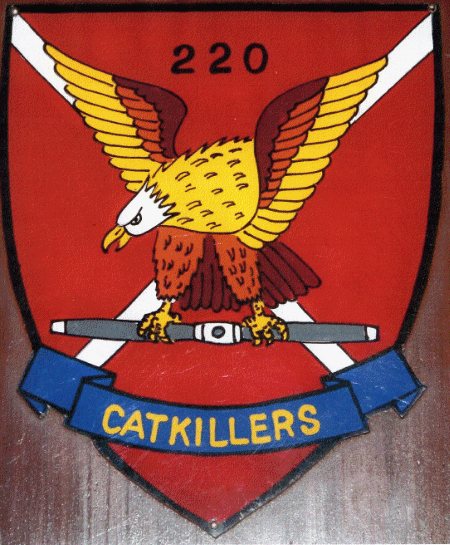
Paragraph 1: The apparent purpose of the requested Distinctive Designation, "THE CATKILLERS," was to record the least known and least recorded unit logo ever used by the 220th Aviation Company—either as a Surveillance Airplane Company (SAL), Reconnaissance Airplane Company (RAC), or as the 220th Aviation Company (Utility), during its entire history in Vietnam, from July 1965 through December 1971. See the Catkiller History Index and review the evolution of the 220th Aviation Company unit designations and the evolution of its unit patches from "WE OBSERVE", through "CAT KILLERS," "THE CATKILLERS" and return to "CAT KILLERS.")
Paragraph 2: "CATKILLERS" or "CAT KILLERS" might probably have been the most appropriate Distinctive Designation requested by the unit for the following reasons:
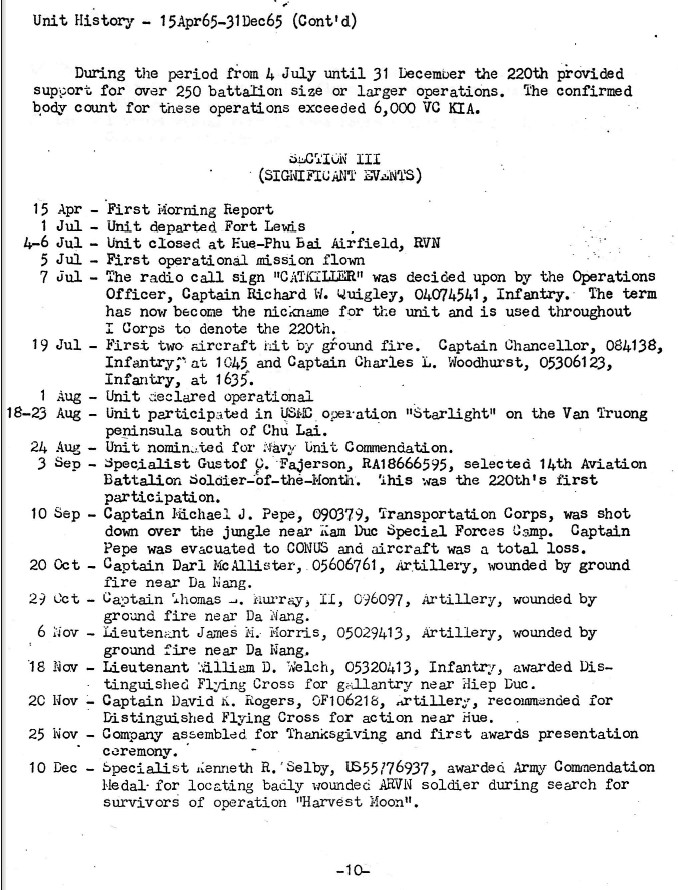
A. Based upon historic usage of the call sign, "CATKILLER," pilots in 1965 initially used this designation along with the last few numbers of their aircraft's tail number to form the call sign. Then in 1966, company pilots in the platoons began to use a letter designator (i.e., Catkiller Alpha through Zulu). After September 1966, the use of "Catkiller" evolved to include the use of a set of numeric designators, bringing the unit then in line with the "rest of the Army." While the headquarters section already identified the commander as Catkiller 6, and his "staff" members traditionally used their unique numerical designations—the XO was Catkiller 5, and the operations officer was Catkiller 3, and so on—each platoon leader's designation was then matched in call sign to the platoon's numerical number: Catkiller 16, 26 and 36 were from the 1st, 2nd and 3rd platoons, and the pilots were assigned numerical numbers in each platoon block of numbers. When the 4th Platoon "came home" from the 219th in March 1967, Catkiller 46 and his platoon rejoined the company family.
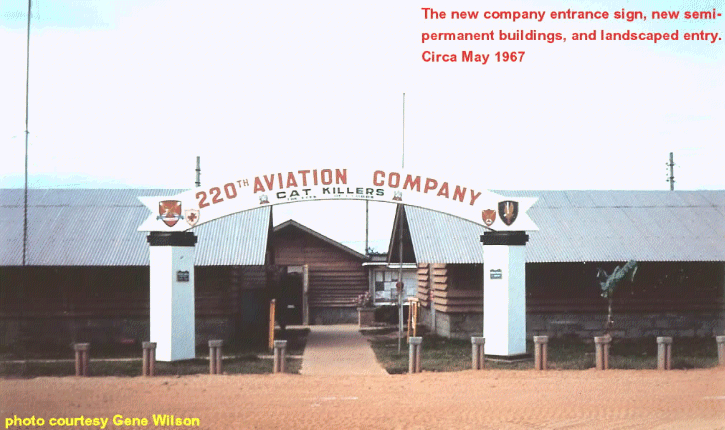
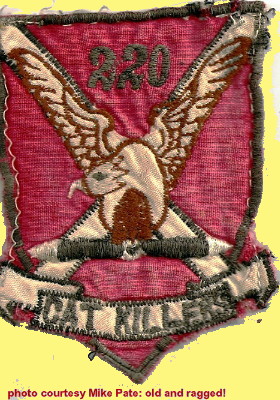
By the appearance of the Company sign over the entrance to the unit area, from 1967 through 1971, and from the unit patches worn on uniforms of all personnel, both officers and soldiers of the 220th Aviation Company, "CAT KILLERS"—most supported units and commands came to identify and associate the 220th Reconnaissance Airplane Company, or 220th Aviation Company (RAC), or the 220th Aviation Company (Utility); as the "Catkillers," or "CATKILLERS," or the "CAT KILLERS."
B. Further, almost all letters of commendation and appreciation addressed to this unit from supported commands referred to the 220th aviators, as members of, and the unit itself, as the 220th Aviation Company or the 220th Reconnaissance Airplane Company. See copies of numerous such letters throughout the Annual Unit History files and contained in the current History Overviews. Only two letters (see copies below), were found in the official Unit History Files that used the words "Catkillers" or "CATKILLERS" in official correspondence.
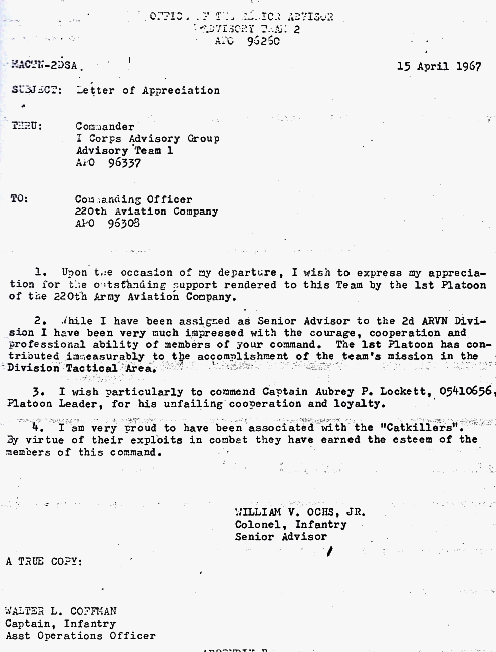
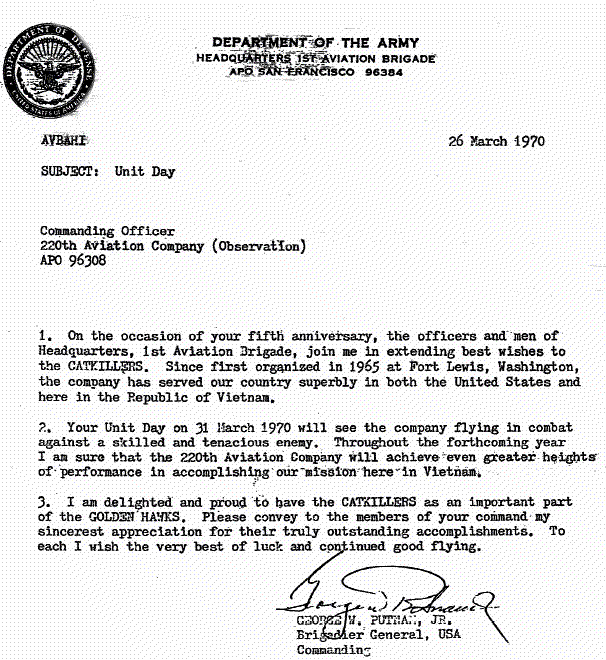
C. Higher headquarters, when identifying this unit, particularly in any mention of the unit verbally, used the call sign or nick-name designation, "Catkillers" or "CATKILLERS." As noted above, within historical records we located only very rare use of the call sign or nick-name in official correspondence. To date, we have not located the use of "THE CATKILLERS" in any official correspondence of record.
D. Finally, all men of the 220th Aviation Company, both those who have served with the 220th in the past and those serving now, proudly identify themselves as Catkillers.
NOTE: It would appear that the final sub-paragraph D, above, could not have been spoken or written better.
Compiler: Gene Wilson (your current Volunteer Historian)
A "Catkiller" with considerable historical knowledge, but certainly not necessarily the "last word."
Addendum to Supplement:
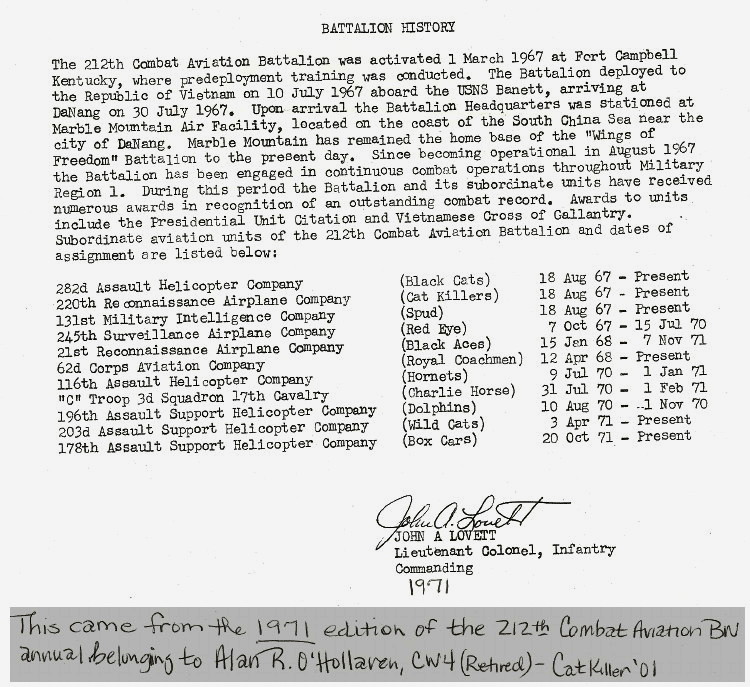
NOTE: Upon the departure (in May 1971) of the commander who made this request, both the new (and last) Company Commander of the 220th Aviation Company (Utility), or (RAC), as it was then called, and the then Battalion Commander of the 212th Combat Aviation Battalion, acknowledged the nick–name of the 220th Aviation Company as the "Cat Killers" or "CAT KILLERS" —the name that remained with the unit until inactivation of the 220th Aviation Company in December 1971. As confusing as it may appear, see the attachments.
Communication with the Office of the Chief of Military History merely revealed that what the requesting Commander requested was granted—whether with or without any further knowledge of the basis for the request and whether the unit as a whole desired the particular Distinctive Designation. The action was and is an official entry in the 220th Aviation Company Unit History files.
The Office of the Chief of Military History further indicated that all individual entries on the 220th Aviation Company web site's Catkiller History Index and other related research documents, including this Supplement, are acceptable for filing in its repository.
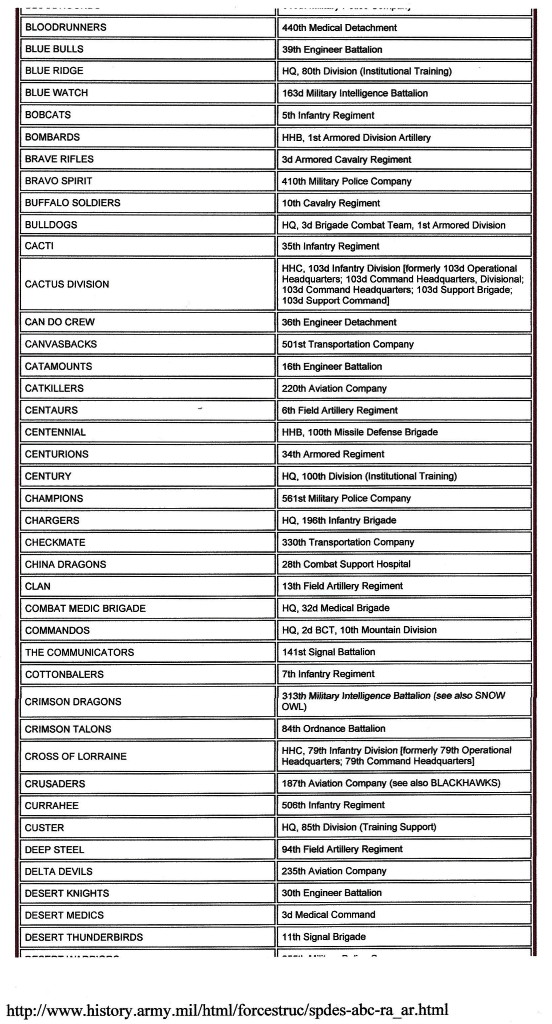
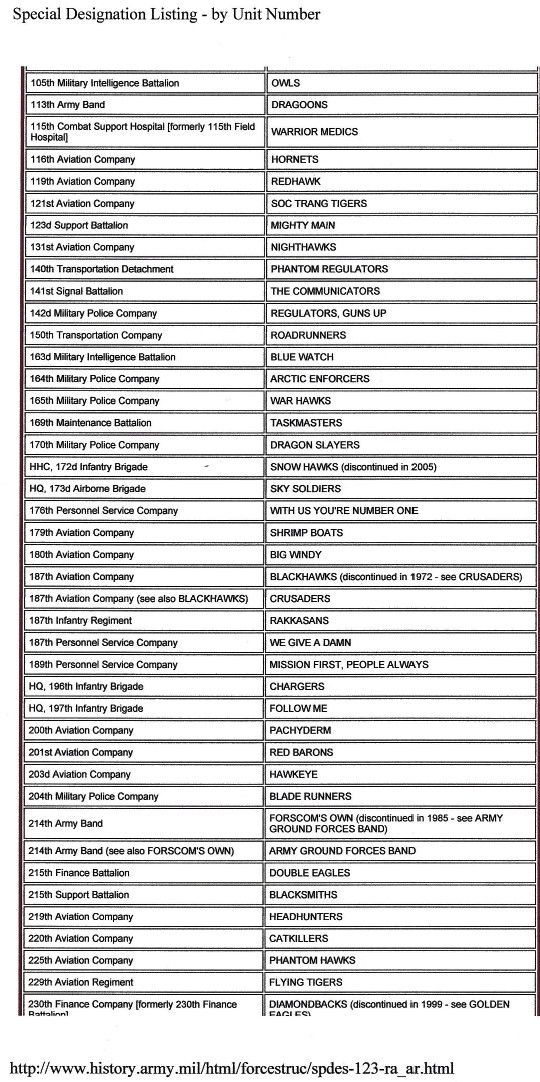
Also attached are extract copies of the Chief of Military History recognized current listings (www.history.army.mil/html/forcestruc/orghist.html) of the Unit Distinctive Designations, by Designation and by Unit, updated as of 21 November 2011, , in which the word "The" has been intentionally removed from the Distinctive Designation in this listing except for "The Old Guard", the 3rd Infantry Regiment — the Ceremonial Unit of the Military District of Washington. However, there are other unit special designations which include the word "The".
If we honor the spoken word of Dick Quigley and the recorded written words of Bill Schmale, then Executive Officer and Unit Historian, as noted in the Annual Unit History of the 220th Aviation Company for 1965, there is little doubt that we were, should be, and will always be best known as the "CATKILLERS."